What is workslop?
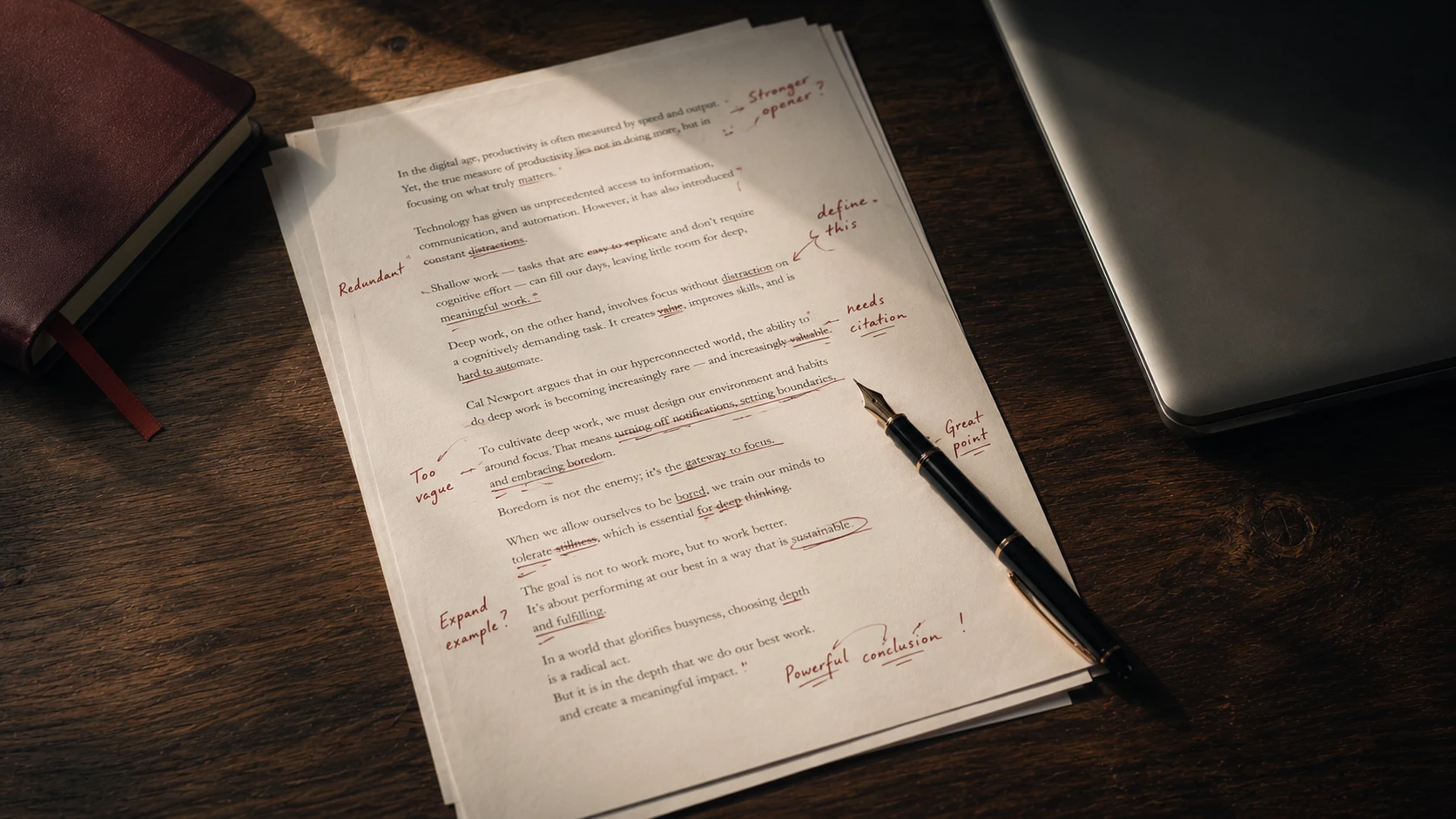
Workslop is AI-generated work that looks finished but isn't.
Texts that sound good but lack context. Drafts that have to be checked line by line. Long summaries that say nothing concrete. Proposals that need rewriting because the message doesn't quite land.
The term was popularised by a BetterUp Labs study published in Harvard Business Review in September 2025. The authors' definition gets to the point:
AI-generated output that masquerades as useful work but lacks the substance to meaningfully advance a task.
It has caught on quickly because it describes what many companies are experiencing without having been able to name it. If you have ever received an email, a summary or a document that "sounded great but was useless", you already know what we're talking about.
The pattern is always the same
A text comes out more polished, longer and faster than it would by hand. It looks like progress. But when someone has to use it, they have to review context, check data, fix tone or correct errors. The supposed time savings don't disappear: they shift.
And in an SME, that's worse than losing time. It's losing it twice: first generating a poor piece, then fixing it.
This isn't an abstract debate. It's a management debate. If AI enters your company as a vague order like "use it to go faster", the risk isn't that people won't use it. The risk is that they'll use it to comply, fake speed and ship work that isn't actually done.
That's where productivity turns into workslop.
My take, no fluff
Automating badly is more expensive than not automating.
And here "badly" doesn't just mean bad prompts. It means a poor business decision. It means imposing AI without deciding which tasks it's for, with what quality level, with what human review, with what metrics and with what final accountability. If nobody owns the result, workslop appears on its own.
And the main responsibility doesn't lie with the employee trying the tool. BetterUp Labs' research is pretty blunt: the problem starts when leadership pressures people to "use AI" in general terms, while the team is already overloaded, has no clear instructions and gets little support to actually integrate the tools into real work.
This is a very Nexe reading: the problem is not the model, it's the implementation.
That's why I'm not interested in the surface-level approach of "let's put ChatGPT in everyone's hands and see what happens". That isn't transformation. It's pushing risk downward. And then being surprised when the accountant, the project manager or the sales lead has to spend the afternoon fixing documents that were supposed to come done.
Why it actually shows up
Workslop comes from four things at once: vague mandates, overloaded teams, wrong incentives and no rules.
At the top, leadership is pressured to show AI ROI and responds with a generic order: "use it more". At the bottom, the team piles on more tasks with no role redesign or training. The result isn't smart use, it's performative use: looking like you're complying with the directive, even if quality drops and the burden shifts to the recipient.
There's an important difference between "bad prompt" and "bad implementation". A bad prompt is a symptom. The deep cause is a company that hasn't defined what counts as an acceptable output, on which tasks AI makes sense, what review is mandatory and who has the final say. When quality and accountability aren't defined, the real incentive becomes something else: ship something fast that looks acceptable.
The typical Andorran case. An admin at a small advisory firm starts using ChatGPT to draft replies, summarise emails and prepare drafts for clients. At first glance, it seems faster. But there are no approved templates, no criteria for sensitive data, no review checklist and no metric on how many errors are slipping through. The accountant, who was supposed to save time, ends up reviewing every text with more suspicion than before.
Work doesn't disappear. It moves to the more expensive role.
That's why workslop is so treacherous. It doesn't enter loudly. It comes dressed as a nice document, a formal email, a long summary or a "pretty good" proposal. It looks the part. And precisely because of that, it's dangerous.
What it actually costs
The cost of workslop isn't just time. It's rework, distrust, poor coordination and a false sense of progress.
The original study estimated nearly two hours of handling per incident and an invisible monthly cost per employee. But what I find most relevant isn't the financial calculation. It's the human effect: receiving workslop makes people think less of their colleagues. 42% consider them less trustworthy, 37% less intelligent and 32% say they're less willing to work with that person again.
That's slow dynamite for any small team.
The global picture points the same way. A January 2026 Workday study with 3,200 business leaders shows that 85% of employees save between one and seven hours a week with AI, but nearly 40% of that saving is spent verifying, correcting and rewriting. Only 14% report clearly positive and consistent results. And in most organisations, fewer than half of roles have been updated to reflect what should change when AI comes in. They're running 2025 technology inside 2015 work structures.
A grounded scenario in a small advisory firm. Without AI, the admin spends about 5 hours a week drafting and the accountant 1 hour reviewing critical points. Total: 6 hours. With improvised AI (no templates, no criteria), the admin drops to 2 hours but the accountant goes up to 4-5 because they distrust every text. Total: 6-7 hours, and with worse feel. With well-scoped AI (approved templates, selective review where it counts), the admin spends 2.5 hours and the accountant 1-1.5. Total: 3.5-4 hours.
The lesson is simple: badly set up AI doesn't eliminate work. It relocates it to the role where it's most expensive to absorb.
How to avoid it without killing initiative
Workslop drops when the company moves from the generic order to operational discipline.
People who feel competent and in control of the tools are much less likely to produce workslop. Teams with internal trust as well. And employees with clearly positive results are the ones who have received real training and spend the time they save on higher-value work, not simply more of the same.
For an SME, this translates into a system less glamorous than the demos, but much more useful:
- Audit the process first, not the tool. Which tasks you do, in what volume, with what tolerable error rate.
- Start with a scoped pilot. One case, one team, one metric. Not all departments at once.
- Define what counts as an acceptable output. Template, criteria, positive and negative examples. Without this, the team doesn't know where the bar is.
- Keep human review where there's risk. Not paranoid, but selective at the critical points.
- Assign a clear owner. Who's accountable if an output goes wrong. Without an owner, there's no quality.
- Measure beyond time saved. Also review time, corrections, incidents, rework. If you don't measure the real cost, you only measure the appearance.
At Nexe Labs I don't approach applied AI with the "use it everywhere" narrative. I do the opposite. We look at where there is volume, where there are repeatable patterns, where errors are reviewable, and where the cost of validation doesn't eat the savings.
If you can't measure a process, it's not ready to be automated. And if you don't know who's accountable for the result, even less so.
When to stop the pilot
There's also something many people don't want to hear: not every AI adoption should be scaled. Some pilots should be stopped.
If review time stays high, if errors keep slipping through, or if the system only produces more noise, the problem is not "we just need more training". The problem is that this case isn't well chosen or well enough defined. Recognising that early saves much more than insisting.
That's the most uncomfortable part of a good implementation: having the judgement (and the courage) to go back to the previous situation when the pilot hasn't worked.
What to take away
Workslop isn't an AI problem. It's a management problem that AI makes more visible.
The important question isn't "which tool do you choose". It's "what discipline are you going to put around the tool". Without that discipline, AI won't make you more productive. It will make you faster at generating work that someone else will have to do over.